Austria
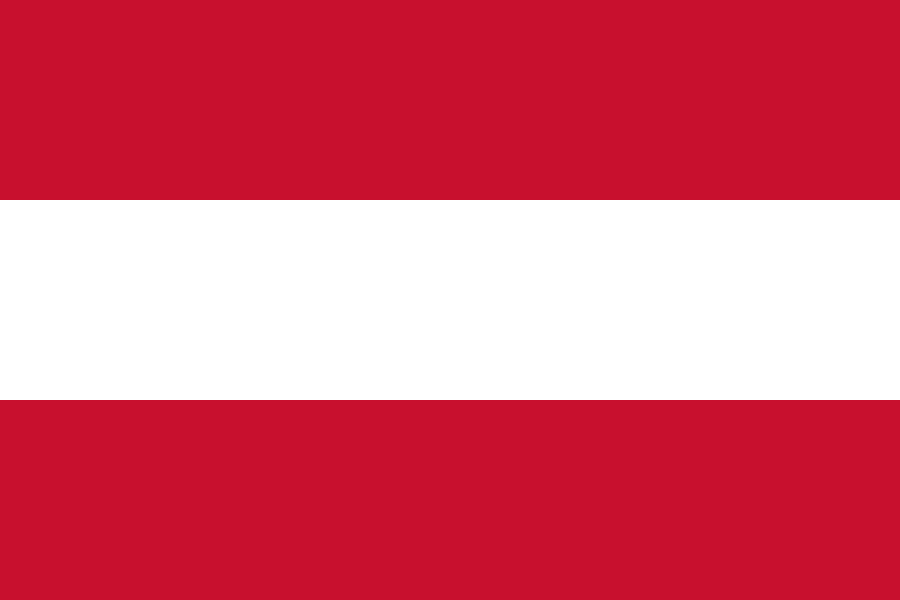
| Facts & Figures | |
|---|---|
President: Heinz Fischer (2004)
Chancellor: Werner Faymann (2008)
Land area: 31,942 sq mi (82,730 sq km); total area: 32,382 sq mi (83,870 sq km)
Population (2014 est.): 8,223,062 (growth rate: 0.01%); birth rate 8.76/1000; infant mortality rate: 4.16/1000; life expectancy: 80.17
Capital and largest city (2011 est.):Vienna, 1.72 million
Other large cities: Graz, 219,500; Linz, 185,300; Salzburg, 145,500; Innsbruck, 115,600
Monetary units: Euro (formerly schilling)
|

Geography
Slightly smaller than Maine, Austria includes much of the mountainous territory of the eastern Alps (about 75% of the area). The country contains many snowfields, glaciers, and snowcapped peaks, the highest being the Grossglockner (12,530 ft; 3,819 m). The Danube is the principal river. Forests and woodlands cover about 40% of the land.
Government
Federal republic.
Federal republic.
History
Settled in prehistoric times, the central European land that is now Austria was overrun in pre-Roman times by various tribes, including the Celts. After the fall of the Roman Empire, of which Austria was part, the area was invaded by Bavarians and Slavic Avars. Charlemagne conquered the area in 788 and encouraged colonization and Christianity. In 1252, Ottokar, king of Bohemia, gained possession, only to lose the territories to Rudolf of Hapsburg in 1278. Thereafter, until World War I, Austria's history was largely that of its ruling house, the Hapsburgs. Austria emerged from the Congress of Vienna in 1815 as the continent's dominant power. The Ausgleichof 1867 provided for a dual sovereignty, the empire of Austria and the kingdom of Hungary, under Franz Joseph I, who ruled until his death on Nov. 21, 1916. The Austrian-Hungarian minority rule of this immensely diverse empire, which included German, Czech, Romanian, Serbian, and many other lands, became increasingly difficult in an age of emerging nationalist movements. When Archduke Francis Ferdinand was assassinated by a Serbian nationalist in Sarajevo in 1914, World War I, as well as the destruction of the Austro-Hungarian Empire, began.
During World War I, Austria-Hungary was one of the Central powers with Germany, Bulgaria, and Turkey, and the conflict left the country in political chaos and economic ruin. Austria, shorn of Hungary, was proclaimed a republic in 1918, and the monarchy was dissolved in 1919. A parliamentary democracy was set up by the constitution of Nov. 10, 1920. To check the power of Nazis advocating union with Germany, Chancellor Engelbert Dolfuss in 1933 established a dictatorship, but he was assassinated by the Nazis on July 25, 1934. Kurt von Schuschnigg, his successor, struggled to keep Austria independent, but on March 12, 1938, German troops occupied the country, and Hitler proclaimed its Anschluss (union) with Germany, annexing it to the Third Reich.
Settled in prehistoric times, the central European land that is now Austria was overrun in pre-Roman times by various tribes, including the Celts. After the fall of the Roman Empire, of which Austria was part, the area was invaded by Bavarians and Slavic Avars. Charlemagne conquered the area in 788 and encouraged colonization and Christianity. In 1252, Ottokar, king of Bohemia, gained possession, only to lose the territories to Rudolf of Hapsburg in 1278. Thereafter, until World War I, Austria's history was largely that of its ruling house, the Hapsburgs. Austria emerged from the Congress of Vienna in 1815 as the continent's dominant power. The Ausgleichof 1867 provided for a dual sovereignty, the empire of Austria and the kingdom of Hungary, under Franz Joseph I, who ruled until his death on Nov. 21, 1916. The Austrian-Hungarian minority rule of this immensely diverse empire, which included German, Czech, Romanian, Serbian, and many other lands, became increasingly difficult in an age of emerging nationalist movements. When Archduke Francis Ferdinand was assassinated by a Serbian nationalist in Sarajevo in 1914, World War I, as well as the destruction of the Austro-Hungarian Empire, began.
During World War I, Austria-Hungary was one of the Central powers with Germany, Bulgaria, and Turkey, and the conflict left the country in political chaos and economic ruin. Austria, shorn of Hungary, was proclaimed a republic in 1918, and the monarchy was dissolved in 1919. A parliamentary democracy was set up by the constitution of Nov. 10, 1920. To check the power of Nazis advocating union with Germany, Chancellor Engelbert Dolfuss in 1933 established a dictatorship, but he was assassinated by the Nazis on July 25, 1934. Kurt von Schuschnigg, his successor, struggled to keep Austria independent, but on March 12, 1938, German troops occupied the country, and Hitler proclaimed its Anschluss (union) with Germany, annexing it to the Third Reich.
Austria Establishes Neutrality
After World War II, the United States and Britain declared the Austrians a “liberated” people, but the Russians prolonged the occupation. Finally Austria concluded a state treaty with the USSR and the other occupying powers and regained its independence on May 15, 1955. The second Austrian republic, established Dec. 19, 1945, on the basis of the 1920 constitution (amended in 1929), was declared by the federal parliament to be permanently neutral.
On June 8, 1986, former UN secretary-general Kurt Waldheim was elected to the ceremonial office of president in a campaign marked by controversy over his alleged links to Nazi war crimes in Yugoslavia. Austria became a member of the European Union in 1995, but it retained its strict constitutional neutrality and forbade the stationing of foreign troops on its soil.
In Feb. 2000, the conservative People's Party formed a coalition with the far-right Freedom Party, headed by Jörg Haider. A nationalist against immigration, Haider had made several controversial remarks praising some Nazi policies, which he has since recanted. His gradual rise to power was credited to voters weary of decades of stasis under the rule of the Social Democrats. The European Union condemned Austria's new coalition, froze diplomatic contacts, and imposed sanctions, accusing Haider of being a racist, xenophobe, and Nazi sympathizer. Given the controversy, Haider chose not to join the government, but he continued to wield influence from the sidelines.
Failed Coalitions Hinder the Republic's Government
In Sept. 2002, the coalition between the People's Party and the Freedom Party dissolved after a shake-up in the Freedom Party, instigated by Haider. In Nov. 2002, the People's Party made large gains in general elections. After failed coalition talks with other parties, the People's Party again formed a government with the Freedom Party in Feb. 2003. A government plan to overhaul the country's pension program led to widespread strikes in May and June 2003—the first national strikes in decades.
In 2004, Heinz Fischer, known as the “left conscience” of the Social Democrat Party, was elected to the largely ceremonial role of president.
Austria's tough laws against Nazi propaganda led to a three-year prison sentence for infamous British historian David Irving, who pleaded guilty in Feb. 2006 to denying the Holocaust. In Dec. 2006, he was released from prison early, and deported to England.
Three months after elections, Austria's two main parties formed a coalition government in Jan. 2007. The leader of the Social Democrats, Alfred Gusenbauer, became chancellor.
Parliament passed a law in June 2007 that lowered the voting age in Austria to 16.
Infighting Causes Government Collapse
On July 7, 2008, the Austrian government collapsed after months of struggling between the two major political parties, the Social Democratic Party and the People's Party. Elections are expected to be held in September. The chancellor, Alfred Gusenbauer, announced that he would not run for reelection. The new Social Democratic Party leader and transport minister, Werner Faymann, will be the Social Democrat candidate.
In September 2008, the right-wing parties made tremendous gains in parliamentary elections. The Social Democratic Party of Austria won 29.3% of the vote (57 of 183 seats), the Austrian People's Party 26% (51), the Freedom Party of Austria 17.5% (34), the Alliance for the Future of Austria 10.7% (21), the Greens 10.4% (20), and the Liberal Forum 2.1% (0). Turnout was 78.8%. On October 8, 2008, Faymann was asked by President Fischer to form a new government.
On October 11, 2008, during a crucial time in Austrian politics, the leader of the far-right Alliance for the Future of Austria, Jorg Haider, died in a car crash. On November 23, 2008, a coalition was agreed upon. Faymann began serving as Chancellor of Austria on December 2, 2008.
Parliament Passes Controversial Reforms to Regulate Islam
In Feb. 2015, the Austrian parliament passed controversial reforms in an effort to control Islamist radicalism. The reforms were to the 1912 law that made Islam an official religion in Austria. The new legislation bans any foreign funding for mosques or imams. However, there were no similar bans made for other religions. For example, Christians could still receive foreign funding for their churches.
The new legislation was condemned internationally. Mehmet Gormez, leader of Turkey's religious affairs, released this statement, “Austria will go back 100 years in freedom with its Islam bill.” In Austria, there are roughly half a million Muslims, about 6% of the population.
Austria's History
Like most European countries, Austria looks back on a very eventful history. Yet there are some elements of the Austrian character that haven’t changed much over the centuries: the partiality for indulgence, beauty, and cultivation has always been a driving force in the country’s past and present...
The Early Days
The area of today’s Austria, that is the fertile Danube Valley and the Alpine valleys, were already settled in the Paleolithic Age (until approx. 8000 BC). Around 400 BC, Celtic peoples from Western Europe settled in the eastern Alps. A Celtic state, Noricum, developed around the region's ironworks in the second century BC. From the 7th century BC onwards one of the main regions of Celtic occupation was in modern-day Austria, centered around Hallstatt, a large prehistoric salt-mining area. The Hallstatt period, 750 - c.450 BC, is named after this region.
The Romans arrived 200 BC and by 15 BC they dominated the entire area. The most important Roman settlement in Austria was Carnuntum (capital of the Roman province of Pannonia in today’s Lower Austria) which became the center of the Roman fortifications along the Danube. Visit the Archaeology Park with a museum and an amphitheater.
From Ostarrichi to Austria
By the latter half of the second century AD, various German tribes were extending their territory making devastating incursions into Roman territories. By the mid-500s, the Bavarians controlled the territory between the eastern Alps and the Wienerwald region. Around 800 Charlemagne, the king of Franks and eventually Holy Roman Emperor, established a territory in the Danube valley known as the Ostmark (Eastern March). In 996 the Ostmark was first referred to as "Ostarrichi", a clear forerunner of the modern German word "Österreich".
The Babenbergs
Between 976, when Leopold von Babenberg became the margrave of the Ostmark, and 1246, the Duchy of Austria was one of extensive feudal possessions of the Babenberg family. The dynasty established their first residence in Pöchlarn before moving it to Melk in the scenic Wachau region. In the 12th century Henry II moved his residence to Vienna which has remained the capital of the country ever since. Also in the 12th century the Cathedral of Saint Stephan was completed, which became a visible landmark of the city, showing its prominence. Henry II also founded the Schottenstift monastaryin Vienna, in the courtyard of which there is a statue of him to this day.
Beginning of the Habsburg Rule
The HabsburgsSome 100 years later Rudolf I emerged with the crown, beginning six centuries of Habsburg rule in Austria. The centerpiece of their realm was the Imperial Palace in Vienna, today accommodating several museums (Treasury, Sisi Museum) providing a good overview of the Habsburgs.
The Habsburgs increased their influence and power through strategic alliances ratified by marriages. Owing to premature deaths and/or childless marriages within the Burgundian and Spanish dynasties into which his grandfather, Maximilian I (1493-1519), and his father had married, Emperor Charles V (1519-56) inherited not only the Hereditary Lands but also the Franche-Comté and the Netherlands (both of which were French fiefs) and Spain and its empire in the Americas.
Turkish Wars
The Turkish threat, which included unsuccessful sieges of Vienna in 1529 and in 1683, prompted Poland, Venice, and Russia to join the Habsburg Empire in repelling the Turks. In the late 1690s, command of the imperial forces was entrusted to Prince Eugene of Savoy. Under his leadership, Habsburg forces won control of all but a small portion of Hungary by 1699.
Baroque Period
With the end of the Turkish threat, the arts and culture experienced a surge. Splendid edifices such as Schloss Schönbrunn (World Cultural Heritage) or the Salzburger Dom were built; architects like Johann Fischer v. Erlach, Lukas v. Hildebrandt, Jakob Prandtauer, Daniel Gran, Paul Troger, Franz Anton Maulbertsch created exceptional monuments. Under the rule of Empress Maria Theresia (1717-1780) the Habsburg holdings were reformed and united. Following Maria Theresa's death in 1780, her son Joseph II, one of the so-called enlightened monarchs, continued the reforms along the lines pursued by his mother.
From Biedermeier to Jugendstil (Art Nouveau)
The French revolution in 1789 and the rise of Napoleon, who secured French possession of many Austrian territories, proved to be a major threat to the Habsburgs. During the Congress of Vienna (1814/15), held with the purpose of redrawing the continent's political map after Napolen’s defeat, Austrian Chancellor Metternich tried to reconsolidate Austrian power. In 1848 the French philosophy of middle-class revolution reached Austria, but the rebellion was promptly squashed, and Emperor Franz I and Metternich responded by cutting down civil liberties and introducing a strict censorship. As a result the people retreated to their houses, concentrated on the domestic and the non-political; social life came to a halt. The second part of the Biedermeier period was marked by a growing urbanization and industrialization that lead to a new urban middle class. People started to meet again, and the arts were cherished. Artists of this time include painters like Ferdinand Georg Waldmüller and Friedrich Gauermann, the composer Franz Schubert, and the poets Adalbert Stifter, Ferdinand Raimund and Franz Grillparzer.
In the end the Emperor Ferdinand I was eventually pressured to abdicate in favor of his nephew Emperor Franz Joseph I, whose 68-year reign was one of Austria’s longest. Together with his wife Elisabeth, the legendary "Sisi", he shaped the image of the Austrian imperial rule. Under his rule Vienna became of the Europe’s most important metropolises and the center of a multinational state extending from Hungary to North Italy and deep into southern Europe.
Johann Strauß, the King of Waltz, was celebrated all over the world for his wonderful musical compositions. Sigmund Freud was the founder of the psychoanalytic school of psychology, a movement that popularized the theory that unconscious motives control much behavior. Around 1900 the Vienna Jugendstil (Art Nouveau) peaked during which forward-looking artists and designers seceded from the mainstream salon exhibitions, to exhibit on their own in more congenial surroundings. Noted Jugendstil artists include the painters Gustav Klimt and Egon Schiele, and the architects Otto Wagner and Adolf Loos. A walk along the Vienna Ringstraße boulevard with its splendid buildings, a visit to the Sisi or Sigmund Freud Museum or the Österreichischen Galerie Belvedere provide a good overview of this epoch.
The 20th Century
Moving Times
Brimming with ethnic tensions and locked into a rigid system of alliances from the 19th century wars, the Austro-Hungarian monarchy was a catastrophe waiting to happen. The necessary spark was the assassination of the Austrian archduke and heir to the throne, Franz Ferdinand in June 1914 in Sarajevo. Austria’s declaration of war against Serbia marked the beginning of World War I. Emperor Franz Joseph dies in 1916 and after the end of the war in 1918 the first Republic of Austria was established, ending the 640-year old Habsburg dynasty. The young republic suffered massive inflation, unemployment, and near economic collapse. In 1933, the weak coalition government between the Christian-Social and the Social-Democratic parties gave way when Engelbert Dollfuss became Chancellor in 1932 as head of a right-wing coalition government, designed to tackle the problems caused by the Depression. In May 1934 Doffluss declared martial law in order to protect Austria from Hitler. In July Dollfuss was shot and killed by Nazis in an attempted coup.
On March 12, 1938, German troops marched into Austria and the country was incorporated into the German Reich ruled by Adolf Hitler. After the end of World War II in 1945, Austria was restored to its 1937 frontiers and occupied by the victorious allies – the USA, the Soviet Union, the UK, and France – for a decade.
The 21st Century
On May 15, 1955, the Austrian State Treaty was ratified, with Austria declaring its permanent neutrality. Thanks to its location near the “Iron Curtain”, Austria soon developed into a nerve center between the West and the East. After the 1956 Hungarian Revolution and the 1968 Prague Spring Invasion, Austria grants asylum to the refugees. Austria is also host country of many international organizations (UNO, OPEC) as well as host of many important conference and summit meetings. The Iron Curtain fell in 1989/90; in 1995 Austria becomes a member of the European Union.

No comments:
Post a Comment