AUSTRALIA

Australia officially the Common wealth of Australia, is a country comprising the mainland of the Australian continent, the island of Tasmania and numerous smaller islands. It is the world's sixth-largest country by total area. Neighbouring countries include Papua New Guinea, Indonesia and East Timor to the north; the Solomon Islands and Vanuatu to the north-east; and New Zealand to the south-east.
For about 50,000 years before the first British settlement in the late 18th century,Australia was inhabited by indigenous Australians, who spoke languages grouped into roughly 250 language groups. After the European discovery of the continent by Dutch explorers in 1606, Australia's eastern half was claimed by Great Britain in 1770 and initially settled through penal transportation to the colony of New South Wales from 26 January 1788. The population grew steadily in subsequent decades; the continent was explored and an additional five self-governingcrown colonies were established. On 1 January 1901, the six colonies federated, forming the Commonwealth of Australia. Since federation, Australia has maintained a stable liberal democratic political system that functions as afederal parliamentary constitutional monarchy comprising six states and several territories. The population of 24 million is highly urbanised and heavily concentrated in the eastern states and on the coast.
Australia is a developed country and one of the wealthiest in the world, with the world's 12th-largest economy. In 2014 Australia had the world's fifth-highest per capita income. Australia's military expenditure is the world's 13th-largest. With the second-highest human development index globally, Australia ranks highly in many international comparisons of national performance, such as quality of life, health, education, economic freedom, and the protection of civil liberties and political rights.Australia is a member of the United Nations, G20, Commonwealth of Nations, ANZUS,Organisation for Economic Co-operation and Development (OECD), World Trade Organization, Asia-Pacific Economic Cooperation, and the Pacific Islands Forum
History
European arrival


A British settlement was established in Van Diemen's Land, now known as Tasmania, in 1803, and it became a separate colony in 1825.The United Kingdom formally claimed the western part of Western Australia (the Swan River Colony) in 1828.Separate colonies were carved from parts of New South Wales: South Australia in 1836, Victoria in 1851, and Queensland in 1859. The Northern Territory was founded in 1911 when it was excised from South Australia.South Australia was founded as a "free province"—it was never a penal colony. Victoria and Western Australia were also founded "free", but later accepted transported convicts. A campaign by the settlers of New South Wales led to the end of convict transportation to that colony; the last convict ship arrived in 1848.
The indigenous population, estimated to have been between 750,000 and 1,000,000 in 1788,declined for 150 years following settlement, mainly due to infectious disease.Thousands more died as a result of frontier conflict with settlers.A government policy of "assimilation" beginning with the Aboriginal Protection Act 1869 resulted in the removal of many Aboriginal children from their families and communities—often referred to as the Stolen Generations—a practice which may also have contributed to the decline in the indigenous population.The Federal government gained the power to make laws with respect to Aborigines following the 1967 referendum.Traditional ownership of land—aboriginal title—was not recognised until 1992, when the High Court case Mabo v Queensland (No 2)overturned the legal doctrine that Australia had been terra nullius ("land belonging to no one") before the European occupation.
Colonial expansion
A gold rush began in Australia in the early 1850s[54] and the Eureka Rebellion against mining licence fees in 1854 was an early expression of civil disobedience.Between 1855 and 1890, the six colonies individually gained responsible government, managing most of their own affairs while remaining part of the British Empire.The Colonial Office in London retained control of some matters, notably foreign affairs,defence,and international shipping.
Nationhood

On 1 January 1901, federation of the colonies was achieved after a decade of planning, consultation and voting.This established the Commonwealth of Australia as a dominion of the British Empire. The Federal Capital Territory (later renamed the Australian Capital Territory) was formed in 1911 as the location for the future federal capital of Canberra. Melbourne was the temporary seat of government from 1901 to 1927 while Canberra was being constructed.The Northern Territory was transferred from the control of the South Australian government to the federal parliament in 1911.In 1914, Australia joined Britain in fighting World War I, with support from both the outgoing Commonwealth Liberal Party and the incoming Australian Labor Party.Australians took part in many of the major battles fought on the Western Front.Of about 416,000 who served, about 60,000 were killed and another 152,000 were wounded. Many Australians regard the defeat of the Australian and New Zealand Army Corps (ANZACs) at Gallipoli as the birth of the nation—its first major military action. The Kokoda Track campaign is regarded by many as an analogous nation-defining event during World War II.
Britain's Statute of Westminster 1931 formally ended most of the constitutional links between Australia and the UK. Australiaadopted it in 1942,but it was backdated to 1939 to confirm the validity of legislation passed by the Australian Parliament during World War II.The shock of the United Kingdom's defeat in Asia in 1942 and the threat of Japanese invasion caused Australia to turn to the United States as a new ally and protector. Since 1951, Australia has been a formal military ally of the US, under the ANZUS treaty. After World War II Australia encouraged immigration from Europe. Since the 1970s and following the abolition of the White Australia policy, immigration from Asia and elsewhere was also promoted.As a result, Australia's demography, culture, and self-image were transformed. The final constitutional ties between Australia and the UK were severed with the passing of the Australia Act 1986, ending any British role in the government of the Australian States, and closing the option of judicial appeals to thePrivy Council in London.In a 1999 referendum, 55% of voters and a majority in every state rejected a proposal to become a republic with a president appointed by a two-thirds vote in both Houses of the Australian Parliament. Since the election of the Whitlam Government in 1972,there has been an increasing focus in foreign policy on ties with other Pacific Rim nations, while maintaining close ties with Australia's traditional allies and trading partners.
Government
Australia is a federal parliamentary constitutional monarchy with Elizabeth II at its apex as the Queen of Australia, a role that is distinct from her position as monarch of the other Commonwealth realms. The Queen is represented in Australia by the Governor-General at the federal level and by the Governors at the state level, who by convention act on the advice of her ministers. The most notable exercise to date of the Governor-General's reserve powers outside the Prime Minister's request was the dismissal of the Whitlam Government in the constitutional crisis of 1975.
The federal government is separated into three branches:
The legislature: the bicameral Parliament, defined in section 1 of the constitution as comprising the Queen (represented by the Governor-General), the Senate, and the House of Representatives;
The executive: the Federal Executive Council, which in practice gives legal effect to the decisions of the cabinet, comprising the prime minister and ministers of state who advise the Governor-General;
The judiciary: the High Court of Australia and other federal courts, whose judges are appointed by the Governor-General on advice of the Federal Executive Council.
In the Senate (the upper house), there are 76 senators: twelve each from the states and two each from the mainland territories (the Australian Capital Territory and the Northern Territory). The House of Representatives(the lower house) has 150 members elected from single-member electoral divisions, commonly known as "electorates" or "seats", allocated to states on the basis of population,with each original state guaranteed a minimum of five seats.Elections for both chambers are normally held every three years simultaneously; senators have overlapping six-year terms except for those from the territories, whose terms are not fixed but are tied to the electoral cycle for the lower house; thus only 40 of the 76 places in the Senate are put to each election unless the cycle is interrupted by a double dissolution.
Australia's electoral system uses preferential voting for all lower house elections with the exception of Tasmania and the ACT which, along with the Senate and most state upper houses, combine it with proportional representation in a system known as the single transferable vote. Voting is compulsory for all enrolled citizens 18 years and over in every jurisdiction,as is enrolment (with the exception of South Australia). The party with majority support in the House of Representatives forms the government and its leader becomes Prime Minister. In cases where no party has majority support, the Governor-General has the constitutional power to appoint the Prime Minister and, if necessary, dismiss one that has lost the confidence of Parliament.
There are two major political groups that usually form government, federally and in the states: the Australian Labor Party and the Coalition which is a formal grouping of the Liberal Party and its minor partner, the National Party. Within Australian political culture, the Coalition is considered centre-right and the Labor Party is considered centre-left. Independent members and several minor parties have achieved representation in Australian parliaments, mostly in upper houses.
In September 2015, Malcolm Turnbull successfully challenged Abbott for leadership of the Coalition, and was sworn in as the 29th Prime Minister of Australia.The most recent federal election was held on 2 July 2016 and resulted in the Coalition forming a majority government.
The federal government is separated into three branches:
The legislature: the bicameral Parliament, defined in section 1 of the constitution as comprising the Queen (represented by the Governor-General), the Senate, and the House of Representatives;
The executive: the Federal Executive Council, which in practice gives legal effect to the decisions of the cabinet, comprising the prime minister and ministers of state who advise the Governor-General;
The judiciary: the High Court of Australia and other federal courts, whose judges are appointed by the Governor-General on advice of the Federal Executive Council.

.jpg)
In the Senate (the upper house), there are 76 senators: twelve each from the states and two each from the mainland territories (the Australian Capital Territory and the Northern Territory). The House of Representatives(the lower house) has 150 members elected from single-member electoral divisions, commonly known as "electorates" or "seats", allocated to states on the basis of population,with each original state guaranteed a minimum of five seats.Elections for both chambers are normally held every three years simultaneously; senators have overlapping six-year terms except for those from the territories, whose terms are not fixed but are tied to the electoral cycle for the lower house; thus only 40 of the 76 places in the Senate are put to each election unless the cycle is interrupted by a double dissolution.
Australia's electoral system uses preferential voting for all lower house elections with the exception of Tasmania and the ACT which, along with the Senate and most state upper houses, combine it with proportional representation in a system known as the single transferable vote. Voting is compulsory for all enrolled citizens 18 years and over in every jurisdiction,as is enrolment (with the exception of South Australia). The party with majority support in the House of Representatives forms the government and its leader becomes Prime Minister. In cases where no party has majority support, the Governor-General has the constitutional power to appoint the Prime Minister and, if necessary, dismiss one that has lost the confidence of Parliament.
There are two major political groups that usually form government, federally and in the states: the Australian Labor Party and the Coalition which is a formal grouping of the Liberal Party and its minor partner, the National Party. Within Australian political culture, the Coalition is considered centre-right and the Labor Party is considered centre-left. Independent members and several minor parties have achieved representation in Australian parliaments, mostly in upper houses.
In September 2015, Malcolm Turnbull successfully challenged Abbott for leadership of the Coalition, and was sworn in as the 29th Prime Minister of Australia.The most recent federal election was held on 2 July 2016 and resulted in the Coalition forming a majority government.
States and territories
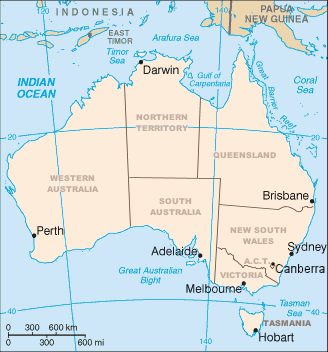
Australia has six states—New South Wales (NSW), Queensland (QLD), South Australia (SA), Tasmania(TAS), Victoria (VIC) and Western Australia (WA)—and two major mainland territories—the Australian Capital Territory (ACT) and the Northern Territory (NT). In most respects these two territories function as states, but the Commonwealth Parliament can override any legislation of their parliaments. By contrast, federal legislation overrides state legislation only in areas that are set out in Section 51 of the Australian Constitution; state parliaments retain all residual legislative powers, including those over schools, state police, the state judiciary, roads, public transport and local government, since these do not fall under the provisions listed in Section 51.
Each state and major mainland territory has its own parliament—unicameral in the Northern Territory, the ACT and Queensland, and bicameral in the other states. The states are sovereign entities, although subject to certain powers of the Commonwealth as defined by the Constitution. The lower houses are known as theLegislative Assembly (the House of Assembly in South Australia and Tasmania); the upper houses are known as the Legislative Council. The head of the government in each state is the Premier and in each territory the Chief Minister. The Queen is represented in each state by a Governor; and in the Northern Territory, the Administrator.In the Commonwealth, the Queen's representative is the Governor-General.
The federal parliament directly administers the following territories:
Ashmore and Cartier Islands
Australian Antarctic Territory
Christmas Island
Cocos (Keeling) Islands
Coral Sea Islands
Heard Island and McDonald Islands
Jervis Bay Territory, a naval base and sea port for the national capital in land that was formerly part of New South Wales
The external territory of Norfolk Island previously exercised considerable autonomy under the Norfolk Island Act 1979 through its own legislative assembly and an Administrator to represent the Queen.In 2015, the Commonwealth Parliament abolished self-government, integrating Norfolk Island into the Australian tax and welfare systems and replacing its legislative assembly with a council.
Macquarie Island is administered by Tasmania, and Lord Howe Island by New South Wales.
Language
Although Australia has no official language, English has always been entrenched as the de facto national language.Australian English is a major variety of the language with a distinctive accent and lexicon,and differs slightly from other varieties of English in grammar and spelling. General Australian serves as the standard dialect. According to the 2011 census, English is the only language spoken in the home for close to 81% of the population. The next most common languages spoken at home are Mandarin (1.7%), Italian (1.5%), Arabic (1.4%), Cantonese (1.3%), Greek (1.3%), and Vietnamese (1.2%);a considerable proportion of first- and second-generation migrants are bilingual. A 2010–2011 study by the Australia Early Development Index found the most common language spoken by children after English was Arabic, followed by Vietnamese, Greek, Chinese, and Hindi.
Over 250 Indigenous Australian languages are thought to have existed at the time of first European contact, of which less than 20 are still in daily use by all age groups.About 110 others are spoken exclusively by older people. At the time of the 2006 census, 52,000 Indigenous Australians, representing 12% of the Indigenous population, reported that they spoke an Indigenous language at home. Australia has a sign language known as Auslan, which is the main language of about 5,500 deaf people.
Religion
Australia has no state religion; Section 116 of the Australian Constitution prohibits the federal government from making any law to establish any religion, impose any religious observance, or prohibit the free exercise of any religion.In the 2011 census, 61.1% of Australians were counted as Christian, including 25.3% as Roman Catholic and 17.1% as Anglican; 22.3% of the population reported having "no religion"; 7.2% identify with non-Christian religions, the largest of these being Buddhism (2.5%), followed by Islam (2.2%), Hinduism (1.3%) andJudaism (0.5%). The remaining 9.4% of the population did not provide an adequate answer.
Before European settlement, the animist beliefs of Australia's indigenous people had been practised for many thousands of years. Mainland Aboriginal Australians' spirituality is known as the Dreamtime and it places a heavy emphasis on belonging to the land. The collection of stories that it contains shaped Aboriginal law and customs.Aboriginal art, story and dance continue to draw on these spiritual traditions. The spirituality and customs of Torres Strait Islanders, who inhabit the islands between Australia and New Guinea, reflected their Melanesian origins and dependence on the sea. The 1996 Australian census counted more than 7000 respondents as followers of a traditional Aboriginal religion.
Since the arrival of the First Fleet of British ships in 1788, Christianity has grown to be the major religion practised in Australia. Christian churches have played an integral role in the development of education, health and welfare services in Australia. For much of Australian history the Church of England (now known as theAnglican Church of Australia) was the largest religious denomination. However, multicultural immigration has contributed to a decline in its relative position, and the Roman Catholic Church has benefitted from recent immigration to become the largest group. Similarly, Islam, Buddhism, Hinduism and Judaism have all grown in Australia over the past half-century.
Australia has one of the lowest levels of religious adherence in the world.In 2001, only 8.8% of Australians attended church on a weekly basis.
Education

School attendance, or registration for home schooling, is compulsory throughout Australia. Education is the responsibility of the individual states and territoriesso the rules vary between states, but in general children are required to attend school from the age of about 5 until about 16. In some states (e.g., Western Australia,the Northern Territory and New South Wales), children aged 16–17 are required to either attend school or participate in vocational training, such as an apprenticeship.
Australia has an adult literacy rate that was estimated to be 99% in 2003. However, a 2011–12 report for the Australian Bureau of Statistics reported that Tasmania has a literacy and numeracy rate of only 50%.In the Programme for International Student Assessment, Australia regularly scores among the top five of thirty major developed countries (member countries of the Organisation for Economic Co-operation and Development). Catholic education accounts for the largest non-government sector.
Australia has 37 government-funded universities and two private universities, as well as a number of other specialist institutions that provide approved courses at the higher education level.The OECD places Australia among the most expensive nations to attend university. There is a state-based system of vocational training, known as TAFE, and many trades conduct apprenticeships for training new tradespeople.About 58% of Australians aged from 25 to 64 have vocational or tertiary qualifications,and the tertiary graduation rate of 49% is the highest among OECD countries. The ratio of international to local students in tertiary education in Australia is the highest in the OECD countries.In addition, 38 percent of Australia's population has a university or college degree, which is among the highest percentages in the world.
Health
Australia has the third and seventh highest life expectancy of males and females respectively in the world. Life expectancy in Australia in 2010 was 79.5 years for males and 84.0 years for females. Australia has the highest rates of skin cancer in the world,while cigarette smoking is the largest preventable cause of death and disease, responsible for 7.8% of the total mortality and disease. Ranked second in preventable causes is hypertension at 7.6%, with obesity third at 7.5%.Australia ranks 35th in the world and near the top of developed nations for its proportion of obese adults and nearly two thirds (63%) of its adult population is either overweight or obese.
Total expenditure on health (including private sector spending) is around 9.8% of GDP.Australia introduced universal health care in 1975.Known as Medicare, it is now nominally funded by an income tax surcharge known as the Medicare levy, currently set at 1.5%.The states manage hospitals and attached outpatient services, while the Commonwealth funds the Pharmaceutical Benefits Scheme (subsidising the costs of medicines) and general practice.
Culture

Since 1788, the primary influence behind Australian culture has been Anglo-Celtic Western culture, with some Indigenousinfluences. The divergence and evolution that has occurred in the ensuing centuries has resulted in a distinctive Australian culture. Since the mid-20th century, American popular culture has strongly influenced Australia, particularly through television and cinema.Other cultural influences come from neighbouring Asian countries, and through large-scale immigration from non-English-speaking nations.
Arts
The rock art of Australia's Indigenous peoples is the oldest and richest in the world, dating as far back as 60,000 years and spread across hundreds of thousands of sites.Traditional designs, patterns and stories infuse contemporary Indigenous Australian art, "the last great art movement of the 20th century"; its exponents include Emily Kame Kngwarreye.During the first century of European settlement, colonial artists, trained in Europe, showed a fascination with the unfamiliar land.The naturalistic, sun-filled works of Arthur Streeton, Tom Roberts and others associated with the 19th-century Heidelberg School—the first "distinctively Australian" movement in Western art—gave expression to a burgeoning Australian nationalism in the lead-up to Federation. While the school remained influential into the new century, modernists such as Margaret Preston, and, later, Sidney Nolan and Arthur Boyd, explored new artistic trends. The landscape remained a central subject matter for Fred Williams, Brett Whiteley and other post-World War II artists whose works, eclectic in style yet uniquely Australian, moved between the figurative and the abstract. The National Gallery of Australia and state galleries maintain collections of Australian and international art.Australia has one of the world's highest attendances of art galleries and museums per head of population.

Australian literature grew slowly in the decades following European settlement though Indigenous oral traditions, many of which have since been recorded in writing, are much older.19th-century writers such as Henry Lawson and Banjo Paterson captured the experience of the bush using a distinctive Australian vocabulary. Their works are still very popular; Paterson's bush poem "Waltzing Matilda" (1895) is regarded as Australia's unofficial national anthem.Miles Franklin is the namesake of Australia's most prestigious literary prize, awarded annually to the best novel about Australian life.Its first recipient, Patrick White, went on to win the Nobel Prize in Literature in 1973.Australian winners of the Booker Prize include Peter Carey, Thomas Keneally and Richard Flanagan.Author David Malouf, playwright David Williamson and poet Les Murray are also renowned literary figures.
Many of Australia's performing arts companies receive funding through the federal government's Australia Council. There is a symphony orchestra in each state, and a national opera company, Opera Australia,well known for its famous soprano Joan Sutherland.At the beginning of the 20th century, Nellie Melba was one of the world's leading opera singers.Ballet and dance are represented by The Australian Ballet and various state companies. Each state has a publicly funded theatre company.
Media

Australia has two public broadcasters (the Australian Broadcasting Corporation and the multicultural Special Broadcasting Service), three commercial television networks, several pay-TV services, and numerous public, non-profit television and radio stations. Each major city has at least one daily newspaper, and there are two national daily newspapers, The Australian and The Australian Financial Review. In 2010, Reporters Without Borders placed Australia 18th on a list of 178 countries ranked by press freedom, behind New Zealand (8th) but ahead of the United Kingdom (19th) and United States (20th).This relatively low ranking is primarily because of the limited diversity of commercial media ownership in Australia; most print media are under the control of News Corporation and Fairfax Media.
Cuisine
Most Indigenous Australian tribal groups subsisted on a simple hunter-gatherer diet of native fauna and flora, otherwise called bush tucker.The first settlers introduced British food to the continent, much of which is now considered typical Australian food, such as the Sunday roast. Multicultural immigration transformed Australian cuisine; post-World War II European migrants, particularly from the Mediterranean, helped to build a thriving Australian coffee culture, and the influence of Asian cultures has led to Australian variants of their staple foods, such as the Chinese-inspired dim sim and Chiko Roll. Vegemite, pavlova,lamingtons and meat pies are regarded as iconic Australian foods.Australian wine is produced mainly in the southern, cooler parts of the country.
Sport and recreation

About 24% of Australians over the age of 15 regularly participate in organised sporting activities. At an international level, Australia has excelled at cricket, field hockey, netball, rugby league, swimming and rugby union. The majority of Australians live within the coastal zone, making the beach a popular recreation spot and an integral part of the nation's identity. Australia is a powerhouse in water-based sports, such as swimming and surfing.The surf life saving movement originated in Australia, and the volunteer lifesaver is one of the country's icons. Nationally, other popular sports include Australian rules football, horse racing, basketball, surfing, soccer, and motor racing. The annual Melbourne Cup horse race and the Sydney to Hobart yacht race attract intense interest.
Australia is one of five nations to have participated in every Summer Olympics of the modern era, and has hosted the Games twice: 1956 in Melbourne and 2000 in Sydney. Australia has also participated in every Commonwealth Games, hosting the event in 1938, 1962, 1982, 2006 and will host the 2018 Commonwealth Games. Australia made its inaugural appearance at the Pacific Games in 2015. As well as being a regular FIFA World Cup participant, Australia has won the OFC Nations Cup four times and the AFC Asian Cup once – the only country to have won championships in two different FIFA confederations. The country regularly competes among the world elite basketball teams as it is among the global top three teams in terms of qualifications to the Basketball Tournament at the Summer Olympics. Other major international events held in Australia include theAustralian Open tennis grand slam tournament, international cricket matches, and the Australian Formula One Grand Prix. The highest-rating television programs include sports telecasts such as the Summer Olympics, FIFA World Cup, The Ashes, Rugby League State of Origin, and the grand finals of the National Rugby League and Australian Football League. Skiing in Australia began in the 1860s and snow sports take place in the Australian Alps and parts of Tasmania.


No comments:
Post a Comment