Saturday, 1 October 2016

Austria

Image result


Facts & Figures
President: Heinz Fischer (2004)
Chancellor: Werner Faymann (2008)
Land area: 31,942 sq mi (82,730 sq km); total area: 32,382 sq mi (83,870 sq km)
Population (2014 est.): 8,223,062 (growth rate: 0.01%); birth rate 8.76/1000; infant mortality rate: 4.16/1000; life expectancy: 80.17
Other large cities: Graz, 219,500; Linz, 185,300; Salzburg, 145,500; Innsbruck, 115,600
Monetary units: Euro (formerly schilling)


Geography

Slightly smaller than Maine, Austria includes much of the mountainous territory of the eastern Alps (about 75% of the area). The country contains many snowfields, glaciers, and snowcapped peaks, the highest being the Grossglockner (12,530 ft; 3,819 m). The Danube is the principal river. Forests and woodlands cover about 40% of the land.

Government

Federal republic.
History
Settled in prehistoric times, the central European land that is now Austria was overrun in pre-Roman times by various tribes, including the Celts. After the fall of the Roman Empire, of which Austria was part, the area was invaded by Bavarians and Slavic Avars. Charlemagne conquered the area in 788 and encouraged colonization and Christianity. In 1252, Ottokar, king of Bohemia, gained possession, only to lose the territories to Rudolf of Hapsburg in 1278. Thereafter, until World War I, Austria's history was largely that of its ruling house, the Hapsburgs. Austria emerged from the Congress of Vienna in 1815 as the continent's dominant power. The Ausgleichof 1867 provided for a dual sovereignty, the empire of Austria and the kingdom of Hungary, under Franz Joseph I, who ruled until his death on Nov. 21, 1916. The Austrian-Hungarian minority rule of this immensely diverse empire, which included German, Czech, Romanian, Serbian, and many other lands, became increasingly difficult in an age of emerging nationalist movements. When Archduke Francis Ferdinand was assassinated by a Serbian nationalist in Sarajevo in 1914, World War I, as well as the destruction of the Austro-Hungarian Empire, began.

During World War I, Austria-Hungary was one of the Central powers with Germany, Bulgaria, and Turkey, and the conflict left the country in political chaos and economic ruin. Austria, shorn of Hungary, was proclaimed a republic in 1918, and the monarchy was dissolved in 1919. A parliamentary democracy was set up by the constitution of Nov. 10, 1920. To check the power of Nazis advocating union with Germany, Chancellor Engelbert Dolfuss in 1933 established a dictatorship, but he was assassinated by the Nazis on July 25, 1934. Kurt von Schuschnigg, his successor, struggled to keep Austria independent, but on March 12, 1938, German troops occupied the country, and Hitler proclaimed its Anschluss (union) with Germany, annexing it to the Third Reich.


Austria Establishes Neutrality

After World War II, the United States and Britain declared the Austrians a “liberated” people, but the Russians prolonged the occupation. Finally Austria concluded a state treaty with the USSR and the other occupying powers and regained its independence on May 15, 1955. The second Austrian republic, established Dec. 19, 1945, on the basis of the 1920 constitution (amended in 1929), was declared by the federal parliament to be permanently neutral.
On June 8, 1986, former UN secretary-general Kurt Waldheim was elected to the ceremonial office of president in a campaign marked by controversy over his alleged links to Nazi war crimes in Yugoslavia. Austria became a member of the European Union in 1995, but it retained its strict constitutional neutrality and forbade the stationing of foreign troops on its soil.
In Feb. 2000, the conservative People's Party formed a coalition with the far-right Freedom Party, headed by Jörg Haider. A nationalist against immigration, Haider had made several controversial remarks praising some Nazi policies, which he has since recanted. His gradual rise to power was credited to voters weary of decades of stasis under the rule of the Social Democrats. The European Union condemned Austria's new coalition, froze diplomatic contacts, and imposed sanctions, accusing Haider of being a racist, xenophobe, and Nazi sympathizer. Given the controversy, Haider chose not to join the government, but he continued to wield influence from the sidelines.


Failed Coalitions Hinder the Republic's Government

In Sept. 2002, the coalition between the People's Party and the Freedom Party dissolved after a shake-up in the Freedom Party, instigated by Haider. In Nov. 2002, the People's Party made large gains in general elections. After failed coalition talks with other parties, the People's Party again formed a government with the Freedom Party in Feb. 2003. A government plan to overhaul the country's pension program led to widespread strikes in May and June 2003—the first national strikes in decades.
In 2004, Heinz Fischer, known as the “left conscience” of the Social Democrat Party, was elected to the largely ceremonial role of president.
Austria's tough laws against Nazi propaganda led to a three-year prison sentence for infamous British historian David Irving, who pleaded guilty in Feb. 2006 to denying the Holocaust. In Dec. 2006, he was released from prison early, and deported to England.
Three months after elections, Austria's two main parties formed a coalition government in Jan. 2007. The leader of the Social Democrats, Alfred Gusenbauer, became chancellor.
Parliament passed a law in June 2007 that lowered the voting age in Austria to 16.

Infighting Causes Government Collapse

On July 7, 2008, the Austrian government collapsed after months of struggling between the two major political parties, the Social Democratic Party and the People's Party. Elections are expected to be held in September. The chancellor, Alfred Gusenbauer, announced that he would not run for reelection. The new Social Democratic Party leader and transport minister, Werner Faymann, will be the Social Democrat candidate.
In September 2008, the right-wing parties made tremendous gains in parliamentary elections. The Social Democratic Party of Austria won 29.3% of the vote (57 of 183 seats), the Austrian People's Party 26% (51), the Freedom Party of Austria 17.5% (34), the Alliance for the Future of Austria 10.7% (21), the Greens 10.4% (20), and the Liberal Forum 2.1% (0). Turnout was 78.8%. On October 8, 2008, Faymann was asked by President Fischer to form a new government.
On October 11, 2008, during a crucial time in Austrian politics, the leader of the far-right Alliance for the Future of Austria, Jorg Haider, died in a car crash. On November 23, 2008, a coalition was agreed upon. Faymann began serving as Chancellor of Austria on December 2, 2008.

Parliament Passes Controversial Reforms to Regulate Islam

In Feb. 2015, the Austrian parliament passed controversial reforms in an effort to control Islamist radicalism. The reforms were to the 1912 law that made Islam an official religion in Austria. The new legislation bans any foreign funding for mosques or imams. However, there were no similar bans made for other religions. For example, Christians could still receive foreign funding for their churches.
The new legislation was condemned internationally. Mehmet Gormez, leader of Turkey's religious affairs, released this statement, “Austria will go back 100 years in freedom with its Islam bill.” In Austria, there are roughly half a million Muslims, about 6% of the population.


Austria's History


Like most European countries, Austria looks back on a very eventful history. Yet there are some elements of the Austrian character that haven’t changed much over the centuries: the partiality for indulgence, beauty, and cultivation has always been a driving force in the country’s past and present...


The Early Days

The area of today’s Austria, that is the fertile Danube Valley and the Alpine valleys, were already settled in the Paleolithic Age (until approx. 8000 BC). Around 400 BC, Celtic peoples from Western Europe settled in the eastern Alps. A Celtic state, Noricum, developed around the region's ironworks in the second century BC. From the 7th century BC onwards one of the main regions of Celtic occupation was in modern-day Austria, centered around Hallstatt, a large prehistoric salt-mining area. The Hallstatt period, 750 - c.450 BC, is named after this region.
The Romans arrived 200 BC and by 15 BC they dominated the entire area. The most important Roman settlement in Austria was Carnuntum (capital of the Roman province of Pannonia in today’s Lower Austria) which became the center of the Roman fortifications along the Danube. Visit the Archaeology Park with a museum and an amphitheater.


From Ostarrichi to Austria

By the latter half of the second century AD, various German tribes were extending their territory making devastating incursions into Roman territories. By the mid-500s, the Bavarians controlled the territory between the eastern Alps and the Wienerwald region. Around 800 Charlemagne, the king of Franks and eventually Holy Roman Emperor, established a territory in the Danube valley known as the Ostmark (Eastern March). In 996 the Ostmark was first referred to as "Ostarrichi", a clear forerunner of the modern German word "Österreich".

The Babenbergs

Between 976, when Leopold von Babenberg became the margrave of the Ostmark, and 1246, the Duchy of Austria was one of extensive feudal possessions of the Babenberg family. The dynasty established their first residence in Pöchlarn before moving it to Melk in the scenic Wachau region. In the 12th century Henry II moved his residence to Vienna which has remained the capital of the country ever since. Also in the 12th century the Cathedral of Saint Stephan was completed, which became a visible landmark of the city, showing its prominence. Henry II also founded the Schottenstift monastaryin Vienna, in the courtyard of which there is a statue of him to this day.

Beginning of the Habsburg Rule

The HabsburgsSome 100 years later Rudolf I emerged with the crown, beginning six centuries of Habsburg rule in Austria. The centerpiece of their realm was the Imperial Palace in Vienna, today accommodating several museums (Treasury, Sisi Museum) providing a good overview of the Habsburgs.
The Habsburgs increased their influence and power through strategic alliances ratified by marriages. Owing to premature deaths and/or childless marriages within the Burgundian and Spanish dynasties into which his grandfather, Maximilian I (1493-1519), and his father had married, Emperor Charles V (1519-56) inherited not only the Hereditary Lands but also the Franche-Comté and the Netherlands (both of which were French fiefs) and Spain and its empire in the Americas.

Turkish Wars

The Turkish threat, which included unsuccessful sieges of Vienna in 1529 and in 1683, prompted Poland, Venice, and Russia to join the Habsburg Empire in repelling the Turks. In the late 1690s, command of the imperial forces was entrusted to Prince Eugene of Savoy. Under his leadership, Habsburg forces won control of all but a small portion of Hungary by 1699.

Baroque Period

With the end of the Turkish threat, the arts and culture experienced a surge. Splendid edifices such as Schloss Schönbrunn (World Cultural Heritage) or the Salzburger Dom were built; architects like Johann Fischer v. Erlach, Lukas v. Hildebrandt, Jakob Prandtauer, Daniel Gran, Paul Troger, Franz Anton Maulbertsch created exceptional monuments. Under the rule of Empress Maria Theresia (1717-1780) the Habsburg holdings were reformed and united. Following Maria Theresa's death in 1780, her son Joseph II, one of the so-called enlightened monarchs, continued the reforms along the lines pursued by his mother.

From Biedermeier to Jugendstil (Art Nouveau)


The French revolution in 1789 and the rise of Napoleon, who secured French possession of many Austrian territories, proved to be a major threat to the Habsburgs. During the Congress of Vienna (1814/15), held with the purpose of redrawing the continent's political map after Napolen’s defeat, Austrian Chancellor Metternich tried to reconsolidate Austrian power. In 1848 the French philosophy of middle-class revolution reached Austria, but the rebellion was promptly squashed, and Emperor Franz I and Metternich responded by cutting down civil liberties and introducing a strict censorship. As a result the people retreated to their houses, concentrated on the domestic and the non-political; social life came to a halt. The second part of the Biedermeier period was marked by a growing urbanization and industrialization that lead to a new urban middle class. People started to meet again, and the arts were cherished. Artists of this time include painters like Ferdinand Georg Waldmüller and Friedrich Gauermann, the composer Franz Schubert, and the poets Adalbert Stifter, Ferdinand Raimund and Franz Grillparzer.
In the end the Emperor Ferdinand I was eventually pressured to abdicate in favor of his nephew Emperor Franz Joseph I, whose 68-year reign was one of Austria’s longest. Together with his wife Elisabeth, the legendary "Sisi", he shaped the image of the Austrian imperial rule. Under his rule Vienna became of the Europe’s most important metropolises and the center of a multinational state extending from Hungary to North Italy and deep into southern Europe.
Johann Strauß, the King of Waltz, was celebrated all over the world for his wonderful musical compositions. Sigmund Freud was the founder of the psychoanalytic school of psychology, a movement that popularized the theory that unconscious motives control much behavior. Around 1900 the Vienna Jugendstil (Art Nouveau) peaked during which forward-looking artists and designers seceded from the mainstream salon exhibitions, to exhibit on their own in more congenial surroundings. Noted Jugendstil artists include the painters Gustav Klimt and Egon Schiele, and the architects Otto Wagner and Adolf Loos. A walk along the Vienna Ringstraße boulevard with its splendid buildings, a visit to the Sisi or Sigmund Freud Museum or the Österreichischen Galerie Belvedere provide a good overview of this epoch.

The 20th Century

Moving Times

Brimming with ethnic tensions and locked into a rigid system of alliances from the 19th century wars, the Austro-Hungarian monarchy was a catastrophe waiting to happen. The necessary spark was the assassination of the Austrian archduke and heir to the throne, Franz Ferdinand in June 1914 in Sarajevo. Austria’s declaration of war against Serbia marked the beginning of World War I. Emperor Franz Joseph dies in 1916 and after the end of the war in 1918 the first Republic of Austria was established, ending the 640-year old Habsburg dynasty. The young republic suffered massive inflation, unemployment, and near economic collapse. In 1933, the weak coalition government between the Christian-Social and the Social-Democratic parties gave way when Engelbert Dollfuss became Chancellor in 1932 as head of a right-wing coalition government, designed to tackle the problems caused by the Depression. In May 1934 Doffluss declared martial law in order to protect Austria from Hitler. In July Dollfuss was shot and killed by Nazis in an attempted coup.
On March 12, 1938, German troops marched into Austria and the country was incorporated into the German Reich ruled by Adolf Hitler. After the end of World War II in 1945, Austria was restored to its 1937 frontiers and occupied by the victorious allies – the USA, the Soviet Union, the UK, and France – for a decade.

The 21st Century


On May 15, 1955, the Austrian State Treaty was ratified, with Austria declaring its permanent neutrality. Thanks to its location near the “Iron Curtain”, Austria soon developed into a nerve center between the West and the East. After the 1956 Hungarian Revolution and the 1968 Prague Spring Invasion, Austria grants asylum to the refugees. Austria is also host country of many international organizations (UNO, OPEC) as well as host of many important conference and summit meetings. The Iron Curtain fell in 1989/90; in 1995 Austria becomes a member of the European Union.

Azerbaijan

Flag of Azerbaijan


Facts & Figures


Republic of Azerbaijan

President: Ilham Aliyev (2003)

Prime Minister: Artur Rasizade (2003)

Land area: 33,436 sq mi (86,600 sq km); total area: 33,436 sq mi (86,600 sq km)

Population (2014 est.): 9,686,210 (growth rate: 0.99%); birth rate: 16.96/1000; infant mortality rate: 26.67/1000; life expectancy: 71.91

Capital and largest city (2011 est.):Baku, 2.123 million

Other large cities (2004 est.): Ganja, 303,000; Sumgait, 280,500

Monetary unit: Manat
Flag of Azerbaijan
Index


  1. Azerbaijan Main Page
  2. Economic Future Looks Promising
  3. Tensions Increase with Armenia and Iran
  4. Aliyev Wins Third Term, but International Observes Call Election Unfair

Geography

Azerbaijan is located on the western shore of the Caspian Sea at the southeast extremity of the Caucasus. The region is a mountainous country, and only about 7% of it is arable land. The Kura River Valley is the area's major agricultural zone.

Government

Constitutional republic.


History

Northern Azerbaijan was known as Caucasian Albania in ancient times. The area was the site of many conflicts involving Arabs, Kazars, and Turks. After the 11th century, the territory became dominated by Turks and eventually was a stronghold of the Shiite Muslim religion and Islamic culture. The territory of Soviet Azerbaijan was acquired by Russia from Persia through the Treaty of Gulistan in 1813 and the Treaty of Turkamanchai in 1828.

After the Bolshevik Revolution, Azerbaijan declared its independence from Russia in May 1918. The republic was reconquered by the Red Army in 1920 and was annexed into the Transcaucasian Soviet Socialist Republic in 1922. It was later reestablished as a separate Soviet Republic on Dec. 5, 1936. Azerbaijan declared independence from the collapsing Soviet Union on Aug. 30, 1991.

Since 1988, Azerbaijan and Armenia have been feuding over the enclave of Nagorno-Karabakh. The majority of the enclave's inhabitants are Armenian Christians agitating to secede from the predominantly Muslim Azerbaijan and join with Armenia. War broke out in 1988 when Nagorno-Karabakh tried to break away and annex itself to Armenia, and 30,000 died before a cease-fire agreement was reached in 1994, with Armenia regaining its hold over the disputed enclave. Final plans on the status of Nagorno-Karabakh have yet to be determined.Economic Future Looks Promising

The country's economic troubles are expected to be transformed through Western investment in Azerbaijan's oil resources, an untapped reserve whose estimated worth is trillions of dollars. Since 1994, the Azerbaijan state oil company (SOCAR) has signed several billion-dollar agreements with international oil companies. Azerbaijan's pro-Western stance and its careful economic management have made it the most attractive of the oil-rich Caspian countries for foreign investment. In the years since its independence, the country has undergone rapid privatization, and the IMF gave it high marks as one of the most successful economic overhauls ever. In Sept. 2002, construction of the 1,100-mile Baku-Tblisi-Ceyhan pipeline (a route through Georgia and Turkey) began. Major investors are Britain's BP (33%), Azerbaijan's SOCAR (25%), the U.S.'s Unocal (8.9%), and Norway's Statoil (8.7%). In July 2006, the pipeline opened.

In 2003, President Heydar Aliyev, who was seriously ill, chose his son as the new prime minister, paving the way for his eventual succession. The opposition protested strenuously. In October elections, the president's son, Ilham Aliyev, was elected president. Heydar Aliyev died in December.

In Nov. 2005 parliamentary elections, Aliyev's New Azerbaijan Party won the largest number of seats. International election monitors declared the election fraudulent, and opposition candidates staged protests.

On Oct. 15, 2008, in presidential elections, Ilham Aliyev won a second term with 89% of the vote. Turnout was about 75% of the population.

On Jan. 1, 2012, Azerbaijan began a two-year term as a non-permanent member of the United Nations Security Council. The country's standard of living and economy continues to grow, including a construction boom in Baku, the capital.


Tensions Increase with Armenia and Iran

On August 31, 2012, Armenia ended diplomatic relations with Hungary over the return of Ramil Safarov to Azerbaijan. Safarov was convicted of killing Armenian Lieutenant Gurgen Margaryan in 2004 in Hungary. The Hungarian government released Safarov to Azerbaijan on the assumption that he would serve at least 25 years of his life sentence. Upon his arrival in Azerbaijan, Safarov was pardoned. Once news of the pardon hit, protestors in Armenia burned Hungarian flags and threw eggs at the Hungarian Embassy. Demonstrations were also held in Budapest.

Safarov was welcomed back to Azerbaijan as a national hero. A lieutenant at the time of the murder, Safarov was promoted to rank of major and given eight years of back pay. His pardon and warm welcome threatened to break up the peace process between Azerbaijan and Armenia, a process that has kept the two countries from backsliding into violent feud over the disputed Nagorno-Karabakh territory.

Tension also increased between Azerbaijan and Iran throughout 2012. Neighbors along the Caspian Sea, the two countries found themselves at odds over Israel and Armenia. Iran has long been a supporter of Armenia, Azerbaijan's enemy. Meanwhile, Azerbaijan has been cooperating with Israel over military matters. In March 2012, Azerbaijan authorities arrested 22 people who were suspected in an Iranian plot to kill Israeli and American diplomats. As of September 2012, those allegations remained unproven. In May 2012, Iran Chief of State Ayatollah Ali Khamenei was forbidden entry at the Baku airport and border crossings between the two countries were closed for days. Iran sent warships into the Caspian Sea.


Aliyev Wins Third Term, but International Observes Call Election Unfair

On October 9, 2013, presidential elections were held. Incumbent Ilham Aliyev won a third five-year term, taking 84.6 percent of the vote. Jamil Hasanli, a historian and professor, was a distant second with 5.4 percent. In an interview with The New York Times , Hasanli said his chances were hindered by how quickly the election was held, not having enough funds, the state-controlled media and the lack of international interest.

International observers did become involved after the election. The Organization for Security and Cooperation in Europe (OSCE) called the presidential election unfair and said that they had evidence proving voting irregularities such as ballot-box stuffing. The OSCE released a report on October 10, 2013, that said the election was “undermined by limitations on the freedoms of expression, assembly and association that did not guarantee a level playing field for candidates. Continued allegations of candidate and voter intimidation and a restrictive media environment marred the campaign. Significant problems were observed throughout all stages of Election Day processes and underscored the serious nature of the shortcomings.” However, Aliyev's government denied the accusations.

                         Azerbaijan has been inhabited by several tribes since ancient times. In fact, archeologically it is one of the oldest spots of human dwellings which can traced to the Azykh cave and number of other habitations dating to the Stone Age. Tribal formations in Azerbaijan started in 3rd millenium B.C. of which the Manna and Medes were very powerful and advanced tribes.

The Medes tribe invaded the Manna tribe in 6th century B.C who were eventually conquered, even after much resistance. The Medes tribes were of Indo European origins and are ancestors of modern Kurds. Their official religion then was Zoroastrism which spread through the trade of oil and gas. In developing the state of Azerbaijan, Atropatena and Caucasian Albania have played a foremost role. The origin of the name Azerbaijan has been denoted to the ruler of Atropatena- Atropat, which was later altered to its present name. During the rule of Atropatena, Azerbaijan territory was being formed and around the same time Christianity arrived in the region (3rd to 5th century). Among the historical monuments, at Transcaucasus one can get to see the country’s initial churches which were the reason for spiritual and secular transformation in the daily lives of the people. At the beginning of 6th century, Alabnic alphabet system was introduced which uplifted the education system. Culture and traditions of the then Azerbaijan’s have still been preserved in an excellent form.

In the 8th century the Arabs conquered Azerbaijan and made it a part of Arab Khalifat. Along with the Arab rulers, arrived Islam religion bringing with it new traditions and culture. The Azerbaijan’s accepted Islam and began to be known as Muslims.
In the 18th century controversy between Turkey, Russia and Iran adversely affected Azerbaijan. The Turkmanchay Treaty between Russia and Iran in 1828 divided the country in two parts with the southern part consolidated in Iran and northern with Russia.
The 20th century turned out to be a 360 degree transformation for the country as oil exploration began on a large with 95% of Russia’s oil extraction depending upon Azerbaijan. Baku became the centre of world attraction and political, socio-economic life entered into a new transition.


Stone Age:
Pre historic excavations at Gobustan especially it’s rock paintings.

4th century B.C:
Emergence of two strong kingdoms, Caucasian Albania in north and Atropatan in south.

First Golden Age (9th -12th century A.D.):
Shirvanshah dynasty's governance from 7th century to 14th century A.D. Literature, arts and music prospered in this era. Great poet Nizami Ganjevi who created the epic ‘Khamsa’ born in this era.

Second Golden Age (15th -16th century A.D.):
Rule of Shah Ismail (Khatai) the First from the 15th century. An excellent ruler and connoisseur of arts, with himself being a poet. Established Azeri Turkish as state language of the vast empire of Safavids.

Partition of Azerbaijan:
After the decline of Safavids Empire in the 19th century, Russia and Persia divided Azerbaijan along the Araz River with the northern part under Russian control and southern ruled by Persia.

Transformation of Azerbaijan in the 20th century:
After the massive discovery of oil in Azerbaijan, the region transformed completely raising the socio-economic strata of the society with middle class people becoming millionaires.

Azerbaijan Democratic Republic (1918-1920):
Under the leadership of Mehmet Emin Rasulzadeh, the first Azerbaijan Democratic Republic was established with Georgian’s, Azerbaijanis, Russians, Armenian’s and Jewish leaders being included in its parliament.

Independence of Azerbaijan from Russia:
After 70 years of Russia rule, Azerbaijan’s won their Independence on October 18, 1991. Many martyrs had sacrificed their lives so that their country could see this day. In fact Azerbaijan is the only country with no Russian military force on its base. Today despite the fact that the oil and natural gas industry is the premium reason for growth in economy, people are facing economic hardships due to inflation and non-oil industries. But the situation has slowly improved and is improving with time as World Bank declared the country as top 10 reformer in 2008.

AUSTRALIA

File:Flag of Australia (converted).svg


Australia officially the Common wealth of Australia, is a country comprising the mainland of the Australian continent, the island of Tasmania and numerous smaller islands. It is the world's sixth-largest country by total area. Neighbouring countries include Papua New Guinea, Indonesia and East Timor to the north; the Solomon Islands and Vanuatu to the north-east; and New Zealand to the south-east.

For about 50,000 years before the first British settlement in the late 18th century,Australia was inhabited by indigenous Australians, who spoke languages grouped into roughly 250 language groups. After the European discovery of the continent by Dutch explorers in 1606, Australia's eastern half was claimed by Great Britain in 1770 and initially settled through penal transportation to the colony of New South Wales from 26 January 1788. The population grew steadily in subsequent decades; the continent was explored and an additional five self-governingcrown colonies were established. On 1 January 1901, the six colonies federated, forming the Commonwealth of Australia. Since federation, Australia has maintained a stable liberal democratic political system that functions as afederal parliamentary constitutional monarchy comprising six states and several territories. The population of 24 million is highly urbanised and heavily concentrated in the eastern states and on the coast.

Australia is a developed country and one of the wealthiest in the world, with the world's 12th-largest economy. In 2014 Australia had the world's fifth-highest per capita income. Australia's military expenditure is the world's 13th-largest. With the second-highest human development index globally, Australia ranks highly in many international comparisons of national performance, such as quality of life, health, education, economic freedom, and the protection of civil liberties and political rights.Australia is a member of the United Nations, G20, Commonwealth of Nations, ANZUS,Organisation for Economic Co-operation and Development (OECD), World Trade Organization, Asia-Pacific Economic Cooperation, and the Pacific Islands Forum

History

Human habitation of the Australian continent is estimated to have begun between 42,000 and 48,000 years ago,possibly with the migration of people by land bridges and short sea-crossings from what is now Southeast Asia. These first inhabitants may have been ancestors of modern Indigenous Australians.At the time of European settlement in the late 18th century, most Indigenous Australians were hunter-gatherers, with a complex oral culture and spiritual values based on reverence for the land and a belief in the Dreamtime. The Torres Strait Islanders, ethnically Melanesian, were originally horticulturists and hunter-gatherers.The northern coasts and waters of Australia were visited sporadically by fishermen from Maritime Southeast Asia.

European arrival

A painting of Captain James Cook in uniform sitting down in front of a map
Portrait of Captain James Cook, the first European to map the eastern coastline of Australia in 1770
The first recorded European sighting of the Australian mainland, and the first recorded European landfall on the Australian continent, are attributed to the Dutch navigator Willem Janszoon. He sighted the coast of Cape York Peninsula in early 1606, and made landfall on 26 February at the Pennefather River near the modern town of Weipa on Cape York.The Dutch charted the whole of the western and northern coastlines and named the island continent "New Holland" during the 17th century, but made no attempt at settlement. William Dampier, an English explorer and privateer, landed on the north-west coast of New Holland in 1688 and again in 1699 on a return trip. In 1770, James Cook sailed along and mapped the east coast, which he named New South Wales and claimed for Great Britain. With the loss of its American colonies in 1783, the British Government sent a fleet of ships, the "First Fleet", under the command of Captain Arthur Phillip, to establish a new penal colony in New South Wales. A camp was set up and the flag raised at Sydney Cove, Port Jackson, on 26 January 1788, a date which became Australia's national day, Australia Day, although the British Crown Colony of New South Wales was not formally promulgated until 7 February 1788. The first settlement led to the foundation of Sydney, and the exploration and settlement of other regions.
A calm body of water is in the foreground. The shoreline is about 200 metres away. To the left, close to the shore, are three tall gum trees; behind them on an incline are ruins, including walls and watchtowers of light-coloured stone and brick, what appear to be the foundations of walls, and grassed areas. To the right lie the outer walls of a large rectangular four-storey building dotted with regularly spaced windows. Forested land rises gently to a peak several kilometres back from the shore.
Tasmania's Port Arthur penal settlement is one of eleven UNESCO World Heritage-listed Australian Convict Sites.


A British settlement was established in Van Diemen's Land, now known as Tasmania, in 1803, and it became a separate colony in 1825.The United Kingdom formally claimed the western part of Western Australia (the Swan River Colony) in 1828.Separate colonies were carved from parts of New South Wales: South Australia in 1836, Victoria in 1851, and Queensland in 1859. The Northern Territory was founded in 1911 when it was excised from South Australia.South Australia was founded as a "free province"—it was never a penal colony. Victoria and Western Australia were also founded "free", but later accepted transported convicts. A campaign by the settlers of New South Wales led to the end of convict transportation to that colony; the last convict ship arrived in 1848.

The indigenous population, estimated to have been between 750,000 and 1,000,000 in 1788,declined for 150 years following settlement, mainly due to infectious disease.Thousands more died as a result of frontier conflict with settlers.A government policy of "assimilation" beginning with the Aboriginal Protection Act 1869 resulted in the removal of many Aboriginal children from their families and communities—often referred to as the Stolen Generations—a practice which may also have contributed to the decline in the indigenous population.The Federal government gained the power to make laws with respect to Aborigines following the 1967 referendum.Traditional ownership of land—aboriginal title—was not recognised until 1992, when the High Court case Mabo v Queensland (No 2)overturned the legal doctrine that Australia had been terra nullius ("land belonging to no one") before the European occupation.

Colonial expansion

A gold rush began in Australia in the early 1850s[54] and the Eureka Rebellion against mining licence fees in 1854 was an early expression of civil disobedience.Between 1855 and 1890, the six colonies individually gained responsible government, managing most of their own affairs while remaining part of the British Empire.The Colonial Office in London retained control of some matters, notably foreign affairs,defence,and international shipping.


Nationhood
Photo of an ANZAC memorial with an elderly man playing a bugle. Rows of people are seated behind the memorial. Many small white crosses with red poppies have been stuck into the lawn in rows on either side of the memorial.
The Last Post is played at an Anzac Day ceremony in Port Melbourne, Victoria. Similar ceremonies are held in many suburbs and towns.


On 1 January 1901, federation of the colonies was achieved after a decade of planning, consultation and voting.This established the Commonwealth of Australia as a dominion of the British Empire. The Federal Capital Territory (later renamed the Australian Capital Territory) was formed in 1911 as the location for the future federal capital of Canberra. Melbourne was the temporary seat of government from 1901 to 1927 while Canberra was being constructed.The Northern Territory was transferred from the control of the South Australian government to the federal parliament in 1911.In 1914, Australia joined Britain in fighting World War I, with support from both the outgoing Commonwealth Liberal Party and the incoming Australian Labor Party.Australians took part in many of the major battles fought on the Western Front.Of about 416,000 who served, about 60,000 were killed and another 152,000 were wounded. Many Australians regard the defeat of the Australian and New Zealand Army Corps (ANZACs) at Gallipoli as the birth of the nation—its first major military action. The Kokoda Track campaign is regarded by many as an analogous nation-defining event during World War II.

Britain's Statute of Westminster 1931 formally ended most of the constitutional links between Australia and the UK. Australiaadopted it in 1942,but it was backdated to 1939 to confirm the validity of legislation passed by the Australian Parliament during World War II.The shock of the United Kingdom's defeat in Asia in 1942 and the threat of Japanese invasion caused Australia to turn to the United States as a new ally and protector. Since 1951, Australia has been a formal military ally of the US, under the ANZUS treaty. After World War II Australia encouraged immigration from Europe. Since the 1970s and following the abolition of the White Australia policy, immigration from Asia and elsewhere was also promoted.As a result, Australia's demography, culture, and self-image were transformed. The final constitutional ties between Australia and the UK were severed with the passing of the Australia Act 1986, ending any British role in the government of the Australian States, and closing the option of judicial appeals to thePrivy Council in London.In a 1999 referendum, 55% of voters and a majority in every state rejected a proposal to become a republic with a president appointed by a two-thirds vote in both Houses of the Australian Parliament. Since the election of the Whitlam Government in 1972,there has been an increasing focus in foreign policy on ties with other Pacific Rim nations, while maintaining close ties with Australia's traditional allies and trading partners.


Government

Australia is a federal parliamentary constitutional monarchy with Elizabeth II at its apex as the Queen of Australia, a role that is distinct from her position as monarch of the other Commonwealth realms. The Queen is represented in Australia by the Governor-General at the federal level and by the Governors at the state level, who by convention act on the advice of her ministers. The most notable exercise to date of the Governor-General's reserve powers outside the Prime Minister's request was the dismissal of the Whitlam Government in the constitutional crisis of 1975.

The federal government is separated into three branches:
The legislature: the bicameral Parliament, defined in section 1 of the constitution as comprising the Queen (represented by the Governor-General), the Senate, and the House of Representatives;
The executive: the Federal Executive Council, which in practice gives legal effect to the decisions of the cabinet, comprising the prime minister and ministers of state who advise the Governor-General;
The judiciary: the High Court of Australia and other federal courts, whose judges are appointed by the Governor-General on advice of the Federal Executive Council.

Malcolm Turnbull, Prime Minister
Peter Cosgrove, Governor-General


In the Senate (the upper house), there are 76 senators: twelve each from the states and two each from the mainland territories (the Australian Capital Territory and the Northern Territory). The House of Representatives(the lower house) has 150 members elected from single-member electoral divisions, commonly known as "electorates" or "seats", allocated to states on the basis of population,with each original state guaranteed a minimum of five seats.Elections for both chambers are normally held every three years simultaneously; senators have overlapping six-year terms except for those from the territories, whose terms are not fixed but are tied to the electoral cycle for the lower house; thus only 40 of the 76 places in the Senate are put to each election unless the cycle is interrupted by a double dissolution.

Australia's electoral system uses preferential voting for all lower house elections with the exception of Tasmania and the ACT which, along with the Senate and most state upper houses, combine it with proportional representation in a system known as the single transferable vote. Voting is compulsory for all enrolled citizens 18 years and over in every jurisdiction,as is enrolment (with the exception of South Australia). The party with majority support in the House of Representatives forms the government and its leader becomes Prime Minister. In cases where no party has majority support, the Governor-General has the constitutional power to appoint the Prime Minister and, if necessary, dismiss one that has lost the confidence of Parliament.

There are two major political groups that usually form government, federally and in the states: the Australian Labor Party and the Coalition which is a formal grouping of the Liberal Party and its minor partner, the National Party. Within Australian political culture, the Coalition is considered centre-right and the Labor Party is considered centre-left. Independent members and several minor parties have achieved representation in Australian parliaments, mostly in upper houses.

In September 2015, Malcolm Turnbull successfully challenged Abbott for leadership of the Coalition, and was sworn in as the 29th Prime Minister of Australia.The most recent federal election was held on 2 July 2016 and resulted in the Coalition forming a majority government.


States and territories

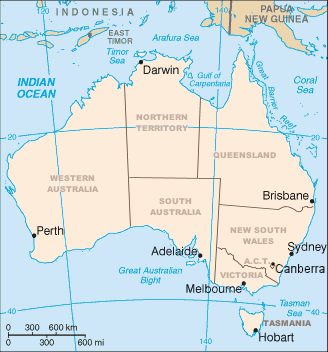
A clickable map of Australia's states, mainland territories and their capitals


Australia has six states—New South Wales (NSW), Queensland (QLD), South Australia (SA), Tasmania(TAS), Victoria (VIC) and Western Australia (WA)—and two major mainland territories—the Australian Capital Territory (ACT) and the Northern Territory (NT). In most respects these two territories function as states, but the Commonwealth Parliament can override any legislation of their parliaments. By contrast, federal legislation overrides state legislation only in areas that are set out in Section 51 of the Australian Constitution; state parliaments retain all residual legislative powers, including those over schools, state police, the state judiciary, roads, public transport and local government, since these do not fall under the provisions listed in Section 51.

Each state and major mainland territory has its own parliament—unicameral in the Northern Territory, the ACT and Queensland, and bicameral in the other states. The states are sovereign entities, although subject to certain powers of the Commonwealth as defined by the Constitution. The lower houses are known as theLegislative Assembly (the House of Assembly in South Australia and Tasmania); the upper houses are known as the Legislative Council. The head of the government in each state is the Premier and in each territory the Chief Minister. The Queen is represented in each state by a Governor; and in the Northern Territory, the Administrator.In the Commonwealth, the Queen's representative is the Governor-General.

The federal parliament directly administers the following territories:
Ashmore and Cartier Islands
Australian Antarctic Territory
Christmas Island
Cocos (Keeling) Islands
Coral Sea Islands
Heard Island and McDonald Islands
Jervis Bay Territory, a naval base and sea port for the national capital in land that was formerly part of New South Wales

The external territory of Norfolk Island previously exercised considerable autonomy under the Norfolk Island Act 1979 through its own legislative assembly and an Administrator to represent the Queen.In 2015, the Commonwealth Parliament abolished self-government, integrating Norfolk Island into the Australian tax and welfare systems and replacing its legislative assembly with a council.

Macquarie Island is administered by Tasmania, and Lord Howe Island by New South Wales.

Language

Although Australia has no official language, English has always been entrenched as the de facto national language.Australian English is a major variety of the language with a distinctive accent and lexicon,and differs slightly from other varieties of English in grammar and spelling. General Australian serves as the standard dialect. According to the 2011 census, English is the only language spoken in the home for close to 81% of the population. The next most common languages spoken at home are Mandarin (1.7%), Italian (1.5%), Arabic (1.4%), Cantonese (1.3%), Greek (1.3%), and Vietnamese (1.2%);a considerable proportion of first- and second-generation migrants are bilingual. A 2010–2011 study by the Australia Early Development Index found the most common language spoken by children after English was Arabic, followed by Vietnamese, Greek, Chinese, and Hindi.

Over 250 Indigenous Australian languages are thought to have existed at the time of first European contact, of which less than 20 are still in daily use by all age groups.About 110 others are spoken exclusively by older people. At the time of the 2006 census, 52,000 Indigenous Australians, representing 12% of the Indigenous population, reported that they spoke an Indigenous language at home. Australia has a sign language known as Auslan, which is the main language of about 5,500 deaf people.


Religion
Religion in Australia[231]
ReligionPercent
Roman Catholic
  
25.3%
Anglican
  
17.1%
Other Christian
  
18.7%
Buddhism
  
2.5%
Islam
  
2.2%
Hinduism
  
1.3%
Judaism
  
0.5%
Other
  
0.8%
No religion
  
22.3%
Undefined or not stated
  
9.4%


Australia has no state religion; Section 116 of the Australian Constitution prohibits the federal government from making any law to establish any religion, impose any religious observance, or prohibit the free exercise of any religion.In the 2011 census, 61.1% of Australians were counted as Christian, including 25.3% as Roman Catholic and 17.1% as Anglican; 22.3% of the population reported having "no religion"; 7.2% identify with non-Christian religions, the largest of these being Buddhism (2.5%), followed by Islam (2.2%), Hinduism (1.3%) andJudaism (0.5%). The remaining 9.4% of the population did not provide an adequate answer.

Before European settlement, the animist beliefs of Australia's indigenous people had been practised for many thousands of years. Mainland Aboriginal Australians' spirituality is known as the Dreamtime and it places a heavy emphasis on belonging to the land. The collection of stories that it contains shaped Aboriginal law and customs.Aboriginal art, story and dance continue to draw on these spiritual traditions. The spirituality and customs of Torres Strait Islanders, who inhabit the islands between Australia and New Guinea, reflected their Melanesian origins and dependence on the sea. The 1996 Australian census counted more than 7000 respondents as followers of a traditional Aboriginal religion.

Since the arrival of the First Fleet of British ships in 1788, Christianity has grown to be the major religion practised in Australia. Christian churches have played an integral role in the development of education, health and welfare services in Australia. For much of Australian history the Church of England (now known as theAnglican Church of Australia) was the largest religious denomination. However, multicultural immigration has contributed to a decline in its relative position, and the Roman Catholic Church has benefitted from recent immigration to become the largest group. Similarly, Islam, Buddhism, Hinduism and Judaism have all grown in Australia over the past half-century.

Australia has one of the lowest levels of religious adherence in the world.In 2001, only 8.8% of Australians attended church on a weekly basis.


Education


Five Australian universities rank in the top 50 of the QS World University Rankings, including the Australian National University (19th).[258]


School attendance, or registration for home schooling, is compulsory throughout Australia. Education is the responsibility of the individual states and territoriesso the rules vary between states, but in general children are required to attend school from the age of about 5 until about 16. In some states (e.g., Western Australia,the Northern Territory and New South Wales), children aged 16–17 are required to either attend school or participate in vocational training, such as an apprenticeship.

Australia has an adult literacy rate that was estimated to be 99% in 2003. However, a 2011–12 report for the Australian Bureau of Statistics reported that Tasmania has a literacy and numeracy rate of only 50%.In the Programme for International Student Assessment, Australia regularly scores among the top five of thirty major developed countries (member countries of the Organisation for Economic Co-operation and Development). Catholic education accounts for the largest non-government sector.

Australia has 37 government-funded universities and two private universities, as well as a number of other specialist institutions that provide approved courses at the higher education level.The OECD places Australia among the most expensive nations to attend university. There is a state-based system of vocational training, known as TAFE, and many trades conduct apprenticeships for training new tradespeople.About 58% of Australians aged from 25 to 64 have vocational or tertiary qualifications,and the tertiary graduation rate of 49% is the highest among OECD countries. The ratio of international to local students in tertiary education in Australia is the highest in the OECD countries.In addition, 38 percent of Australia's population has a university or college degree, which is among the highest percentages in the world.


Health


Australia has the third and seventh highest life expectancy of males and females respectively in the world. Life expectancy in Australia in 2010 was 79.5 years for males and 84.0 years for females. Australia has the highest rates of skin cancer in the world,while cigarette smoking is the largest preventable cause of death and disease, responsible for 7.8% of the total mortality and disease. Ranked second in preventable causes is hypertension at 7.6%, with obesity third at 7.5%.Australia ranks 35th in the world and near the top of developed nations for its proportion of obese adults and nearly two thirds (63%) of its adult population is either overweight or obese.


Total expenditure on health (including private sector spending) is around 9.8% of GDP.Australia introduced universal health care in 1975.Known as Medicare, it is now nominally funded by an income tax surcharge known as the Medicare levy, currently set at 1.5%.The states manage hospitals and attached outpatient services, while the Commonwealth funds the Pharmaceutical Benefits Scheme (subsidising the costs of medicines) and general practice.


Culture

Ornate white building with an elevated dome in the middle, fronted by a golden fountain and orange flowers
The Royal Exhibition Building in Melbourne was the first building in Australia to be listed as a UNESCOWorld Heritage Site in 2004.[286]

Since 1788, the primary influence behind Australian culture has been Anglo-Celtic Western culture, with some Indigenousinfluences. The divergence and evolution that has occurred in the ensuing centuries has resulted in a distinctive Australian culture. Since the mid-20th century, American popular culture has strongly influenced Australia, particularly through television and cinema.Other cultural influences come from neighbouring Asian countries, and through large-scale immigration from non-English-speaking nations.


Arts


The rock art of Australia's Indigenous peoples is the oldest and richest in the world, dating as far back as 60,000 years and spread across hundreds of thousands of sites.Traditional designs, patterns and stories infuse contemporary Indigenous Australian art, "the last great art movement of the 20th century"; its exponents include Emily Kame Kngwarreye.During the first century of European settlement, colonial artists, trained in Europe, showed a fascination with the unfamiliar land.The naturalistic, sun-filled works of Arthur Streeton, Tom Roberts and others associated with the 19th-century Heidelberg School—the first "distinctively Australian" movement in Western art—gave expression to a burgeoning Australian nationalism in the lead-up to Federation. While the school remained influential into the new century, modernists such as Margaret Preston, and, later, Sidney Nolan and Arthur Boyd, explored new artistic trends. The landscape remained a central subject matter for Fred Williams, Brett Whiteley and other post-World War II artists whose works, eclectic in style yet uniquely Australian, moved between the figurative and the abstract. The National Gallery of Australia and state galleries maintain collections of Australian and international art.Australia has one of the world's highest attendances of art galleries and museums per head of population.


Sidney Nolan's Snake mural (1970), held at the Museum of Old and New Artin Hobart, Tasmania, is inspired by the Aboriginal creation myth of theRainbow Serpent, as well as desert flowers in bloom after a drought.[300]


Australian literature grew slowly in the decades following European settlement though Indigenous oral traditions, many of which have since been recorded in writing, are much older.19th-century writers such as Henry Lawson and Banjo Paterson captured the experience of the bush using a distinctive Australian vocabulary. Their works are still very popular; Paterson's bush poem "Waltzing Matilda" (1895) is regarded as Australia's unofficial national anthem.Miles Franklin is the namesake of Australia's most prestigious literary prize, awarded annually to the best novel about Australian life.Its first recipient, Patrick White, went on to win the Nobel Prize in Literature in 1973.Australian winners of the Booker Prize include Peter Carey, Thomas Keneally and Richard Flanagan.Author David Malouf, playwright David Williamson and poet Les Murray are also renowned literary figures.

Many of Australia's performing arts companies receive funding through the federal government's Australia Council. There is a symphony orchestra in each state, and a national opera company, Opera Australia,well known for its famous soprano Joan Sutherland.At the beginning of the 20th century, Nellie Melba was one of the world's leading opera singers.Ballet and dance are represented by The Australian Ballet and various state companies. Each state has a publicly funded theatre company.


Media


Actor playing the bushranger Ned Kelly in The Story of the Kelly Gang(1906), the world's first feature film
The Story of the Kelly Gang (1906), the world's first feature length film, spurred a boom in Australian cinema during the silent film era. After World War I, Hollywood monopolised the industry,and by the 1960s Australian film production had effectively ceased.With the benefit of government support, the Australian New Wave of the 1970s brought provocative and successful films, many exploring themes of national identity, such as Wake in Fright and Gallipoli,while "Crocodile" Dundee and the Ozploitation movement's Mad Max series became international blockbusters.In a film market flooded with foreign content, Australian films delivered a 7.7% share of the local box office in 2015.The AACTAs are Australia's premier film and television awards, and notable Academy Award winners from Australia include Geoffrey Rush, Nicole Kidman, Cate Blanchett and Heath Ledger.


Australia has two public broadcasters (the Australian Broadcasting Corporation and the multicultural Special Broadcasting Service), three commercial television networks, several pay-TV services, and numerous public, non-profit television and radio stations. Each major city has at least one daily newspaper, and there are two national daily newspapers, The Australian and The Australian Financial Review. In 2010, Reporters Without Borders placed Australia 18th on a list of 178 countries ranked by press freedom, behind New Zealand (8th) but ahead of the United Kingdom (19th) and United States (20th).This relatively low ranking is primarily because of the limited diversity of commercial media ownership in Australia; most print media are under the control of News Corporation and Fairfax Media.

Cuisine


Most Indigenous Australian tribal groups subsisted on a simple hunter-gatherer diet of native fauna and flora, otherwise called bush tucker.The first settlers introduced British food to the continent, much of which is now considered typical Australian food, such as the Sunday roast. Multicultural immigration transformed Australian cuisine; post-World War II European migrants, particularly from the Mediterranean, helped to build a thriving Australian coffee culture, and the influence of Asian cultures has led to Australian variants of their staple foods, such as the Chinese-inspired dim sim and Chiko Roll. Vegemite, pavlova,lamingtons and meat pies are regarded as iconic Australian foods.Australian wine is produced mainly in the southern, cooler parts of the country.


Sport and recreation


The Melbourne Cricket Ground is strongly associated with the history and development of cricket and Australian rules football, Australia's two most popular spectator sports.[331]


About 24% of Australians over the age of 15 regularly participate in organised sporting activities. At an international level, Australia has excelled at cricket, field hockey, netball, rugby league, swimming and rugby union. The majority of Australians live within the coastal zone, making the beach a popular recreation spot and an integral part of the nation's identity. Australia is a powerhouse in water-based sports, such as swimming and surfing.The surf life saving movement originated in Australia, and the volunteer lifesaver is one of the country's icons. Nationally, other popular sports include Australian rules football, horse racing, basketball, surfing, soccer, and motor racing. The annual Melbourne Cup horse race and the Sydney to Hobart yacht race attract intense interest.

Australia is one of five nations to have participated in every Summer Olympics of the modern era, and has hosted the Games twice: 1956 in Melbourne and 2000 in Sydney. Australia has also participated in every Commonwealth Games, hosting the event in 1938, 1962, 1982, 2006 and will host the 2018 Commonwealth Games. Australia made its inaugural appearance at the Pacific Games in 2015. As well as being a regular FIFA World Cup participant, Australia has won the OFC Nations Cup four times and the AFC Asian Cup once – the only country to have won championships in two different FIFA confederations. The country regularly competes among the world elite basketball teams as it is among the global top three teams in terms of qualifications to the Basketball Tournament at the Summer Olympics. Other major international events held in Australia include theAustralian Open tennis grand slam tournament, international cricket matches, and the Australian Formula One Grand Prix. The highest-rating television programs include sports telecasts such as the Summer Olympics, FIFA World Cup, The Ashes, Rugby League State of Origin, and the grand finals of the National Rugby League and Australian Football League. Skiing in Australia began in the 1860s and snow sports take place in the Australian Alps and parts of Tasmania.